Running an online education business involves much more than creating lessons and teaching students. Course creators, ed-tech founders and independent educators also manage calendars, learner communications, content preparation, follow-ups, records and countless small operational tasks.
That is where AI for online educators can help reduce the administrative workload surrounding teaching, content creation and learner support. AI tools can accelerate repetitive, text-heavy and process-driven work, but automation alone is rarely the complete answer. Outputs still need context, review and human judgement.
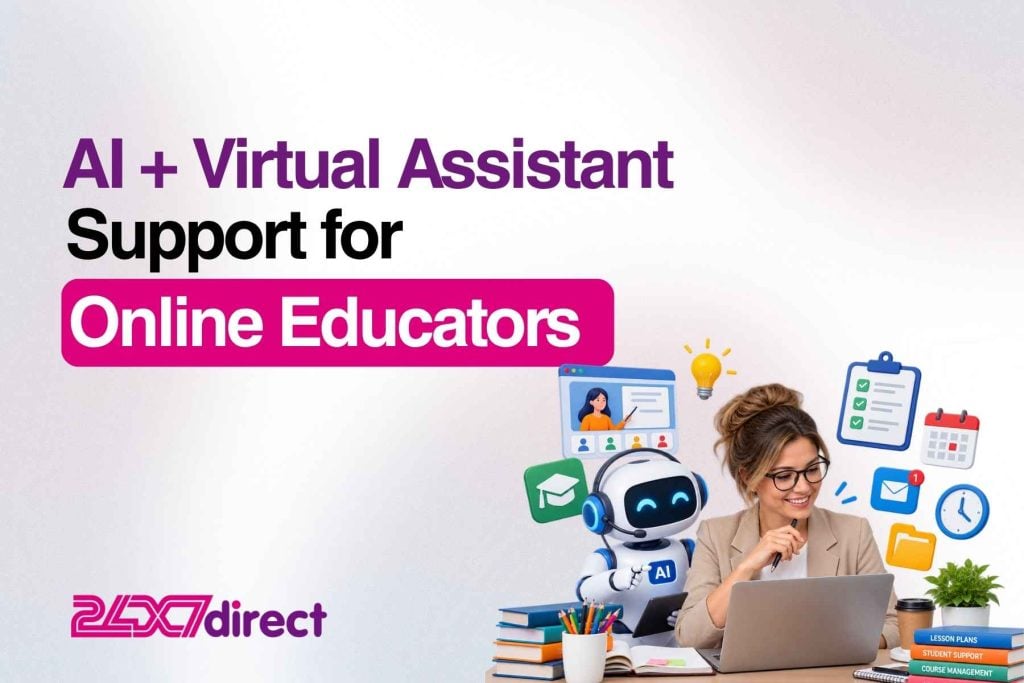
A more practical model combines AI-assisted workflows with human virtual assistant support. AI helps produce drafts, organise information and accelerate routine processes, while a VA reviews outputs, manages exceptions and keeps workflows moving.
Instead of choosing between AI and people, online educators can use each where it performs best.

Why AI for Online Educators Is More Than a Content Tool
When educators think about AI, lesson plans, quizzes and content generation often come to mind first.
Those applications can be useful, but they represent only part of the opportunity. For an online education business, AI can also support the operational work happening around teaching.
Consider a typical week. There may be discovery calls to schedule, learner emails to answer, course materials to prepare, reminders to send, webinar notes to organise and content to repurpose for different channels.
None of these tasks is individually overwhelming. Together, however, they can consume a substantial amount of time.
AI can reduce some of that manual effort. The challenge is deciding what should be automated, what should receive human review and what should remain entirely human-led.
The AI + VA Model: Automation With Human Oversight
There are three broad ways to approach an administrative workflow.
The first is manual: a person completes every step.
The second is highly automated: technology handles as much of the process as possible.
The third is a hybrid model, where AI handles suitable repetitive work and a person manages quality, context and exceptions.
For many online education businesses, the third approach offers a useful balance.
Used this way, AI for online educators becomes part of a structured workflow rather than simply another tool for generating content.
AI is good at accelerating repeatable work
AI can help with first drafts, summaries, categorisation, information extraction and transforming existing material into new formats.
A human team member can then review the output, correct problems, apply business-specific context and complete actions that require judgement.
That distinction matters. The objective should not be to automate everything possible. It should be to remove unnecessary manual effort without compromising the learner experience or creating avoidable operational risk.
1. Streamline Scheduling Without Removing the Human Element
One practical application of AI for online educators is reducing the manual work involved in scheduling, confirmations and routine reminders. Scheduling is a good example of a workflow that can become surprisingly time-consuming.
An independent educator might coordinate coaching calls, group sessions, consultations and internal meetings. Add cancellations and time-zone differences, and simple calendar management can become a recurring distraction.
Automation can handle predictable parts of the process, such as booking availability, confirmations and reminders.
But exceptions still happen.
A learner may need an unusual time. A facilitator may suddenly become unavailable. Two appointments may require manual coordination.
This is where a virtual assistant can provide another layer of support. Instead of the educator becoming involved every time the automated workflow reaches an exception, the assistant can manage suitable scheduling issues according to agreed rules and escalate only when necessary.
The educator gets fewer interruptions without losing appropriate oversight.
2. Use AI to Speed Up Course Content Preparation
Course content is another area where AI for online educators can save preparation time when used thoughtfully.
An educator might use an AI tool to create an initial outline from their notes, summarise a long transcript, suggest discussion questions or turn existing material into a first draft of a learner resource.
The educator should still own the educational substance.
AI-generated material can contain errors, miss important context or produce content that sounds convincing without being appropriate for the audience. Subject-matter review remains essential.
Add VA support around the content workflow
A VA can handle suitable administrative steps surrounding content production.
Once an educator has approved the substance, an assistant might format documents, organise files, upload approved materials to the relevant platform or maintain a content tracker.
This creates a clearer division of labour:
AI accelerates the first pass. The educator provides expertise. The VA supports execution and organisation.
Instead of spending specialist time on every step, the educator concentrates on the parts where their knowledge creates the greatest value.
3. Make Routine Learner Communications More Efficient
Online education creates a constant stream of communication.
Learners may need onboarding information, session reminders, course instructions, follow-ups and answers to common administrative questions.
AI can assist with drafting and adapting routine communications. For example, an existing approved message can be adjusted for a particular program or turned into a clearer first draft.
However, not every learner message should be automated.
Questions involving individual performance, complaints, sensitive circumstances or educational decisions may require careful human judgement.
Create communication tiers
A practical approach is to separate communications by complexity.
Routine administrative messages can use approved templates and automation. Messages requiring some interpretation can be reviewed or handled by an admin professional. Sensitive or educational matters can be escalated to the educator.
This approach can make AI for online educators much more useful because AI operates inside defined boundaries rather than becoming the default response mechanism for every learner interaction.
4. Turn One Piece of Content Into Multiple Assets
This is another practical use of AI for online educators: using existing, educator-approved material to accelerate the first stage of content repurposing while keeping human review in the workflow.
Online educators are often content marketers as well as teachers.
A webinar might need to become a blog outline, email, social media post and course resource. A recorded lesson may contain useful insights for a newsletter or future learning material.
Producing each asset manually can make content marketing difficult to sustain.
AI can help identify themes, summarise transcripts and create first drafts based on educator-approved source material.
A VA can then organise drafts, update a content calendar, format approved material and coordinate publishing tasks where appropriate.
This workflow gives course creators a way to extract more value from content they have already produced without requiring them to personally manage every administrative step.
5. Use AI and VA Support for Better Follow-Ups
Follow-ups are simple until there are dozens of them.
A growing education business may need to follow up with prospective learners, remind existing students about administrative requirements or coordinate information with trainers and other team members.
AI-assisted systems can help categorise messages, summarise previous communication or prepare draft responses.
A VA can provide the human layer by reviewing queues, checking context, sending approved communications and identifying matters requiring the educator’s attention.
The value is not simply faster communication.
A structured follow-up process reduces the chance that important administrative actions remain buried in an inbox while the educator is teaching, creating content or working with learners.
Where Human Oversight Matters Most
Privacy and system access also matter. Online education businesses should ensure their use of AI tools and remote support aligns with applicable privacy, security, contractual and organisational requirements, particularly where personal information is involved. The Office of the Australian Information Commissioner’s guidance on privacy and commercially available AI products provides useful guidance for Australian organisations assessing how AI systems handle personal information.
Think in terms of risk and consequence
For every workflow, consider what happens if the output is wrong.
A poorly worded internal draft may be easy to correct. An inaccurate learner communication or inappropriate educational recommendation can have greater consequences.
Privacy and system access also matter. Online education businesses should ensure their use of AI tools and remote support aligns with applicable privacy, security, contractual and organisational requirements, particularly where personal or sensitive information is involved.
Human oversight is therefore not an inefficiency that automation needs to eliminate. In many workflows, it is part of good operational design.
How to Build an AI + VA Workflow Step by Step
Introducing several AI tools at once can create more complexity rather than less.
Start with one recurring workflow that is currently consuming too much time.
For example, imagine an educator spends several hours each week preparing a learner newsletter.
The process might be redesigned like this:
- The educator provides the key ideas and source material.
- AI creates an initial structure or draft.
- The educator checks educational accuracy and adds expert insight.
- A VA formats the approved content and prepares it in the relevant platform.
- The educator gives final approval where required.
- The VA completes the agreed administrative steps and updates the workflow tracker.
This approach creates defined responsibilities instead of simply adding AI to an existing process.
Once the workflow works reliably, the business can identify the next bottleneck.
What Should AI, a VA and the Educator Each Handle?
The most effective use of AI for online educators depends on giving each part of the workflow to the right resource rather than trying to automate the entire process.
A simple division of responsibilities can prevent confusion.
AI is useful for accelerating drafts, summaries, categorisation and repeatable information processing.
A virtual assistant can manage suitable administrative execution, organisation, quality checks, coordination and exceptions based on established procedures.
The educator should retain responsibility for subject-matter expertise, educational judgement, sensitive decisions and the aspects of the learner relationship that genuinely require their involvement.
These responsibilities will vary between businesses, but the principle remains useful: do not automate work simply because it can be automated, and do not make educators perform administrative tasks simply because they have always performed them.
When Does Virtual Assistant Support Make Sense?
AI may save time on individual tasks without solving the wider capacity problem.
A tool can draft an email, for example, but someone may still need to review the message, update a record, handle the reply and coordinate the next action.
This is where virtual staffing can complement automation.
For Australian education businesses, building a local administrative team can be expensive, particularly during growth. 24×7 Direct connects Australian businesses with skilled professionals from the Philippines and can build customised virtual teams based on business requirements.
With infrastructure provided and no recruitment cost, businesses can add appropriate support without the same upfront requirements associated with building additional internal capacity. Depending on the role and circumstances, virtual staffing can also reduce labour costs by up to 70%.
The strongest use case is not replacing educators. It is keeping educators focused on the work they are uniquely qualified to perform.
Building a Smarter Online Education Operation
The future of AI for online educators is unlikely to be a choice between automation and human support.
For course creators, ed-tech founders and independent educators, a stronger model is to combine the speed of AI with appropriate human oversight.
AI can accelerate scheduling workflows, content preparation, communications and repetitive information processing. A VA can manage suitable administrative execution, review outputs, coordinate processes and deal with exceptions. The educator remains focused on expertise, educational quality and learner relationships.
Start with the repetitive work consuming the most time. Map the workflow, decide what AI can assist with, identify where human oversight belongs and establish clear escalation points.
Used this way, AI and virtual support are not simply productivity tools. Together, they can help build an online education business that has more capacity to grow without placing every new operational task back on the educator.
Frequently Asked Questions
How can online educators use AI?
Online educators can use AI to assist with tasks such as first drafts, content outlines, summaries, communication preparation, information categorisation and parts of scheduling or administrative workflows. Outputs should be reviewed according to the importance and risk of the task.
Can AI replace a virtual assistant for an online educator?
AI and virtual assistants perform different functions. AI can accelerate predictable information-processing and drafting tasks, while a virtual assistant can provide human oversight, coordination, quality checking and exception handling. Combining the two can be more practical than treating them as direct substitutes.
What tasks can an online education VA handle?
Depending on the organisation and role, a VA may support scheduling, inbox management, document organisation, data entry, content administration, routine follow-ups and other process-driven administrative work. Clear procedures and access controls should be established before responsibilities are delegated.
How can course creators start using AI and VA support?
Choose one repetitive workflow that currently consumes significant time. Document each step, identify which parts can be AI-assisted, decide what a VA can manage and retain educator oversight wherever subject expertise or important judgement is required.
Is AI for online educators suitable for learner communication?
It can assist with routine communication workflows, particularly drafting and adapting approved messages. Sensitive enquiries, individual educational advice and communications requiring professional judgement should receive appropriate human review.